
Sewer Line Repair & Replacement in Raleigh & Wake County
Camera first. Then a straight answer: clear it, fix the one bad spot, or replace the line. You see the inside of your own pipe, and you get the price in writing before anybody digs.
Free during business hours (Mon–Fri, 8–5). No trip charge. No estimate fee. No obligation. Sewage backing up right now? We answer after hours.
Sewer lines: the short answer
One pipe carries everything out of your house. When it fails, nothing drains.
Your sewer line (the "lateral") runs from the house to the public main in the street, or to your septic tank. It's underground, so you don't see the problem, you see the symptoms: gurgling, slow drains everywhere, sewage in the tub. The only honest way to know what's wrong is to put a camera in it. That's where every sewer job of ours starts.
We won't quote a sewer replacement we haven't looked at from the inside. Neither should anyone else.
- Whose pipe is it?
- Usually yours, house to main. Raleigh: "You are responsible for the portion of the sewer line that runs from your home to the point where it connects to the City's main sewer line."1 Cary clears blockages from the main up to a property-line cleanout.2 Details by utility.
- How we find the problem
- A camera down the line, from a cleanout or a pulled toilet. It shows roots, a sag, a crack, an offset joint, or a collapse, and a locator tells us exactly where and how deep. You watch the screen with us.
- Three possible answers
- Clear it (a blockage in a sound pipe). Spot repair (one bad joint or section; we dig that spot). Replace it (a line that's failing in several places, sagging, or made of something that's done). We tell you which, and why.
- How long
- Clearing: usually an hour or two. Spot repair: typically a day. Full replacement: one to a few days depending on length, depth and what's in the way. Your water stays on; you just can't use the drains while the line is open.
- What it costs
- Most sewer line repairs in the Raleigh area run between $1,500 and $6,500: a single-spot repair at the low end, a long, deep, full replacement at the high end. Camera inspection first, then a written flat price. What moves it is below.
- How we do it
- Conventional excavation with new PVC, properly bedded so it doesn't sag. We don't do trenchless lining or pipe-bursting. One-year warranty on the work. Permits and inspections where required, pulled and called in by us.
Signs
Three signs it's the sewer line and not a clog
- More than one drain is slow or backing up. One slow sink is a sink. Every drain on the lowest floor acting up at once is the line everything shares. (One drain? That's the drain cleaning page.)
- Sewage where it doesn't belong. In the tub or shower when a toilet flushes, in a floor drain, or at the outside cleanout. Stop running water. Call.
- The yard is telling you. A strip of grass greener than the rest, a soft or sunken spot along the line's path, or a sewer smell outside with no obvious source.
Gurgling toilets, drains that smell, and clogs that come back a few months after they're cleared are the quieter versions of the same thing. A camera settles it.
The camera
What a sewer camera inspection actually shows you
A camera on a push rod goes down the line through a cleanout. A locator on the surface follows the camera head, so we know not just what is wrong but exactly where and how deep. That's the difference between a two-foot-wide hole over the problem and a trench across the yard on a guess. In our video, you can see what roots look like from inside the pipe, and what a joint that's shifted looks like.
What we find, roughly in order of how often: roots at a joint, a belly (sag) holding water, a cracked or broken section, an offset joint, and sometimes nothing wrong at all, in which case the answer was a clog and you've just saved the cost of a dig.
Inside a Raleigh sewer line, 4 minutes. This is what you'd watch on the screen with us.
Whose line is it?
Raleigh and Cary answer this differently. Most people assume they don't.
Before you pay for a sewer repair, it's worth knowing where your responsibility ends. The two biggest utilities in Wake County publish different rules, and the difference is the expensive part under the street.
| Utility | Clearing a blockage | Repairing or replacing broken pipe |
|---|---|---|
| Raleigh Water (Raleigh, Garner, Knightdale, Rolesville, Wake Forest, Wendell, Zebulon) | "If there is a blocked sewer service between the house and the City's sewer main, the property owner is responsible for correcting the problem." The City asks that your plumber "clear the blockage all the way to the City main."1 | "You are responsible for the portion of the sewer line that runs from your home to the point where it connects to the City's main sewer line."3 That includes the part under the street. The City maintains the main itself. |
| Town of Cary | "The Town will clear blockages that occur in the main sewer line or in the sewer lateral, from the main line to the clean out pipe at the edge of the property." The owner handles cleanout to house. No cleanout at the property line means the owner handles the whole lateral.2 | Cary's page is about clearing blockages. Who pays to replace a collapsed lateral in the right-of-way isn't spelled out there. Ask the Town (311) with your address, or ask us and we'll help you find out before we quote. |
| Apex, Holly Springs, Fuquay-Varina, others | Each town has its own practice and they don't all publish it. Apex asks residents to contact Town Water Resources first for sewer issues. When we come out, working out which side of the line the problem is on is part of the free assessment, so you don't pay for the town's pipe. | |
| Septic | The line from the house to the tank is yours and we repair and replace it. We don't service the tank or drain field; we'll tell you who does. | |
Backups from the street: a backwater valve
If your lowest floor sits below the nearest upstream manhole, a main-line surge can push sewage back into your house. Raleigh's guidance: a backwater valve is recommended "if the elevation of the lowest floor of your house is lower than the closest upstream manhole," and to consult a plumber on whether you need one.1 We install them.
What's under Wake County
The year your house was built tells us what we'll probably find
Wake County grew fast and late. Of about 482,000 homes, roughly 90,500 (19%) were built before 1980 and about 50,000 (10%) before 1970.4 Those are the ones with clay and cast iron in the ground, mostly inside the Beltline, in older Cary, downtown Apex and the old parts of Fuquay-Varina and Wake Forest. The rest is plastic, which has its own problems: not the pipe, usually, but how it was put in.
Census ACS 2019–2023 5-year estimates, Wake County, NC. Housing units by year built.
| Built | Likely pipe | How it fails |
|---|---|---|
| Before the 1960s | Vitrified clay tile in short sections, sometimes cast iron near the house | Roots at every joint. Sections shift and crack. Older Raleigh and inside-the-Beltline homes may still have clay. |
| 1960s–1970s | Cast iron, some clay; a few early plastics | Cast iron rusts rough inside and catches everything, then scales and collapses from the bottom. Bellies where it settled. |
| 1980s–1990s | ABS (black) or PVC (white) plastic | Plastic doesn't rust, but joints that weren't glued, fittings set at an angle, and poor bedding show up as leaks and sags 30 years later. The cracked flange on an angled ABS line in a 1989 North Ridge home was one of these. |
| 2000 and newer | PVC | Mostly fine. When it isn't, it's installation: bellies from loose backfill, couplings that let roots in, a tee broken at the street cleanout. The 2002 Fuquay-Varina line we replaced had all three. |
Roots, and the crepe myrtle problem
Roots don't break a sound pipe. They find a joint that's already weeping, and then they never leave. Here in Wake County, crepe myrtles are the usual culprit: everybody has one, they love water, and they're planted right where the sewer line runs out to the street. Cabling cuts the roots; they grow back. A camera tells you whether the joint can be repaired or the line has had it.
The belly
A sag in the line where the ground under it settled. Water sits there, solids settle, and you get a clog that comes back no matter how many times it's cleared. The fix is to dig that section, bed the new pipe on compacted material so it holds grade, and backfill it properly. That's the part of a sewer job you can't see when it's done, and it's the part that decides whether you call us again.
Clear, repair or replace
Three answers. The camera picks, not the salesman.
A blockage in a sound pipe
Grease, wipes, a root ball at one joint, something a kid flushed. We cable or jet the line from the cleanout and run water to prove it's open. If the camera shows the pipe is otherwise fine, you're done. Usually an hour or two.
If the pipe isn't fine, we tell you now, not after the third clearing. On a line that then gets replaced, we've credited the clearing toward the job.
One bad joint or section
The locator puts us right over the problem. We dig that spot, cut out the broken section or the root-filled joint, splice in new PVC with proper couplings, bed it so it holds grade, and backfill. Typically a day.
Right call when the rest of the line is plastic in good shape. Wrong call on old clay or cast iron, where the next joint is next year's call.
A line that's done
Failing in several places, sagging, collapsed, or old clay or cast iron end to end. We dig a trench along the line (or a new route if the old one runs under something), lay new PVC on proper bedding with a new cleanout at the house, test it, and backfill. One to a few days.
Repeated repairs on a failing line cost more than one replacement. We'll show you the footage so you can see why we're saying that.
How a replacement goes
What the two days look like
Camera and locate
We run the camera, mark the route and depth on the ground, and you watch. Then a written flat price for each option. No pressure, no clock. Shut the water off at a fixture if you must; the line will wait.
811 and permits
We call NC 811 and wait the required three working days for the utilities to mark their lines.5 Where a permit and inspection are required, we pull it and schedule it.
Dig
Mini excavator where there's room, shovels where there isn't. We keep the trench to the line and save the sod we can. Most laterals here are 2 to 6 feet down; deeper near the street.
New pipe, bedded right
Old pipe comes out. New PVC goes in on a compacted bed at a steady fall to the main, with a new cleanout where the line leaves the house. This is the step that prevents the next belly.
Test, inspect, backfill
The line is tested and, where required, inspected before anything is covered. Then we backfill in lifts, tamp, rake, and spread straw so the grass comes back. Your drains are back the same day the line goes in.
Sign it
The plumber who did the work signs off on it. One-year warranty. If something's wrong, call us, not a form.
What we don't do: trenchless lining (CIPP) or pipe-bursting. For some lines under a driveway or a big tree it's the right answer, and we'll tell you so and who does it. We also don't service septic tanks or drain fields.
Real jobs
Sewer work in Wake County, signed by the plumber who did it

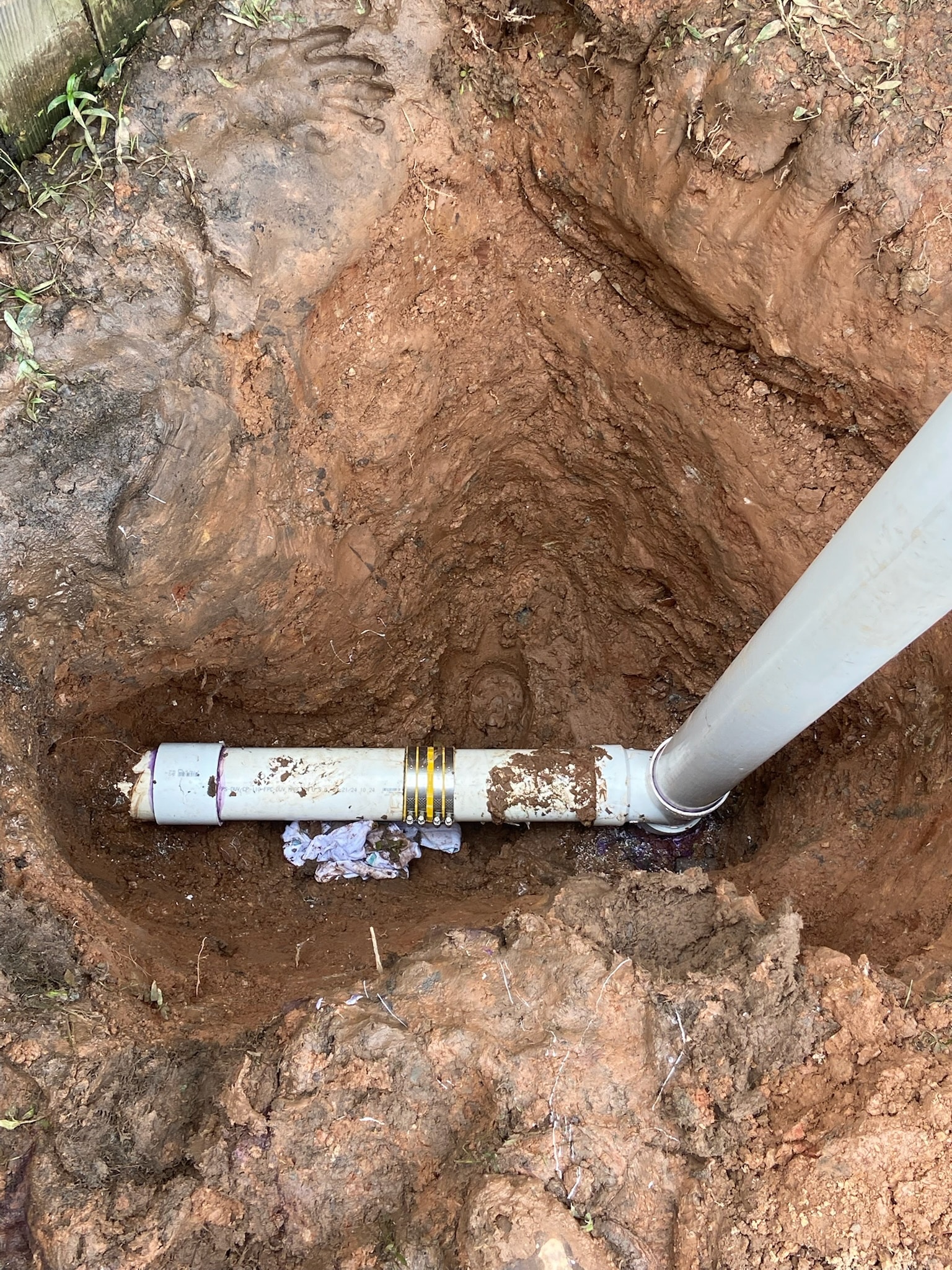
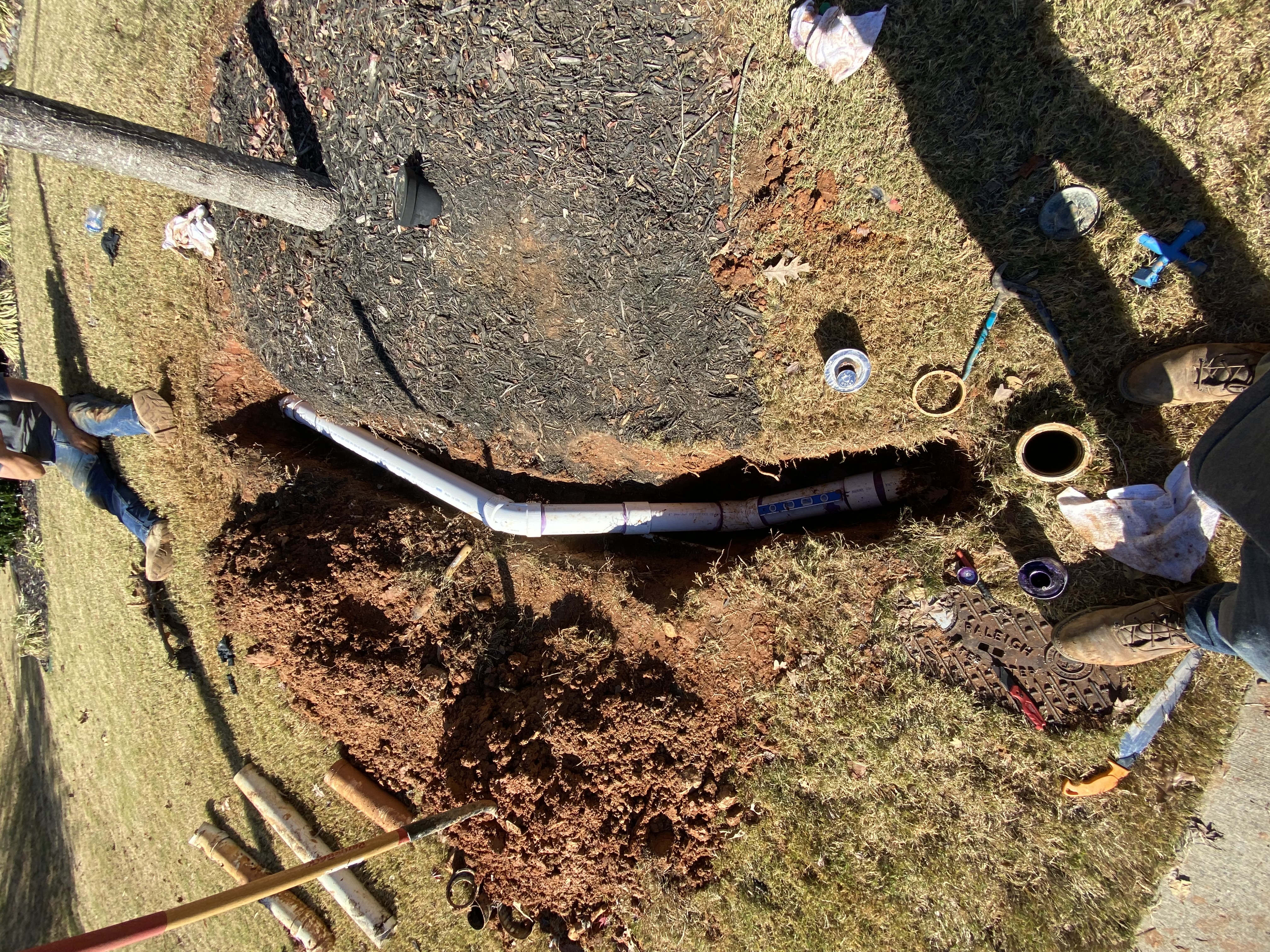
Root-filled, sagging sewer line replaced, house to street
Called for a main-line clog. We cleared it and ran the camera: several bellies, and roots coming in at couplings that were never installed right. A spot repair wasn't honest with that many problems. They chose a full replacement; we credited the clearing. New line from the house to the city cleanout, new cleanout at the house, straw down for the grass. Eight hours.
Signed by Bradly, Lead plumber · Full job →
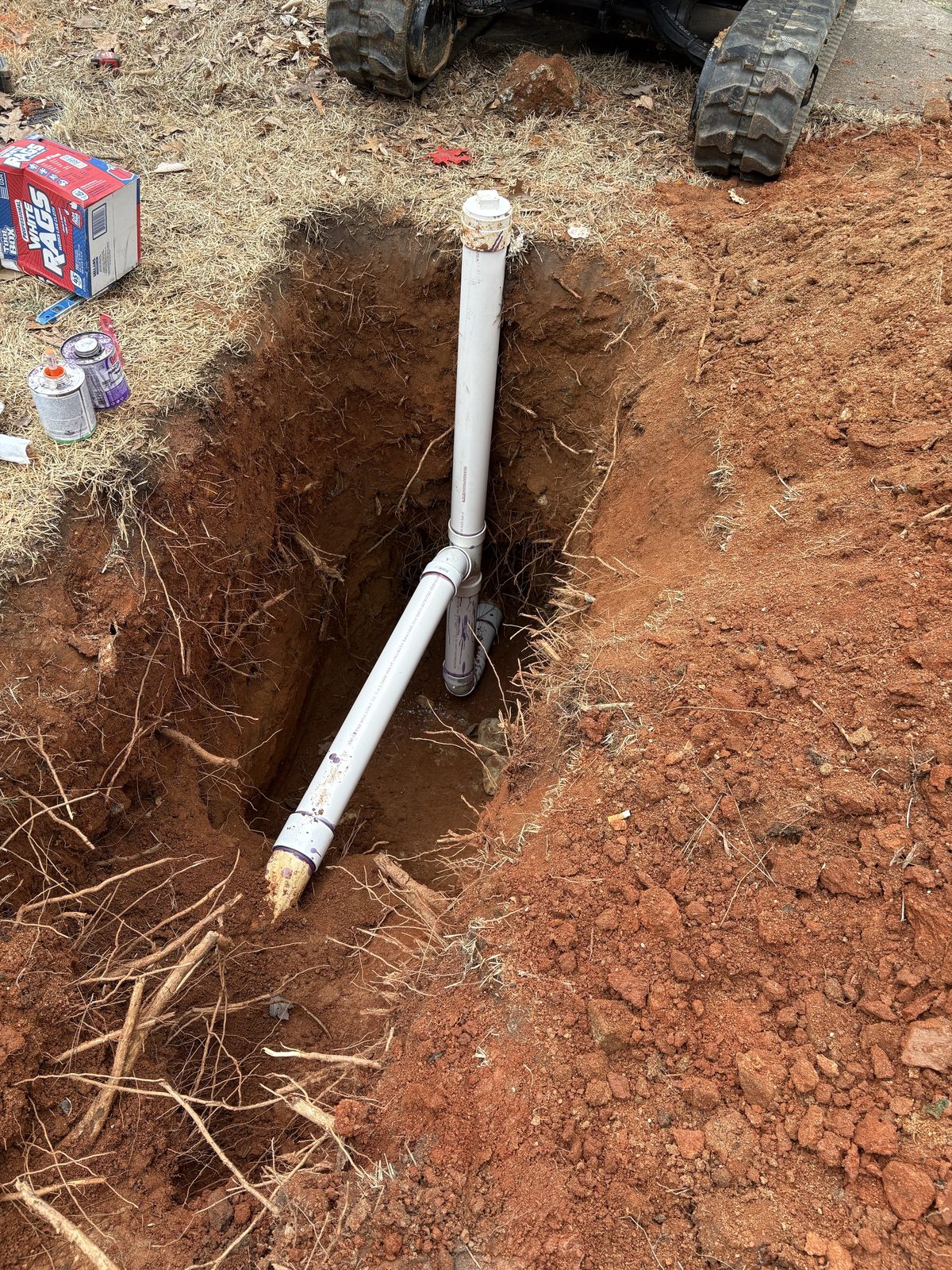
Broken sewer cleanout at the street dug up and replaced
The cleanout at the street was overflowing hard enough to blow its cap off. The camera found a broken tee at the cleanout. Clearing alone would have put them right back here, so they chose to replace the section. Once it was open, the vertical was broken farther down than the camera could show, so more got replaced. Everything new, backfilled, eight hours.
Signed by Bradly, Lead plumber · Full job →
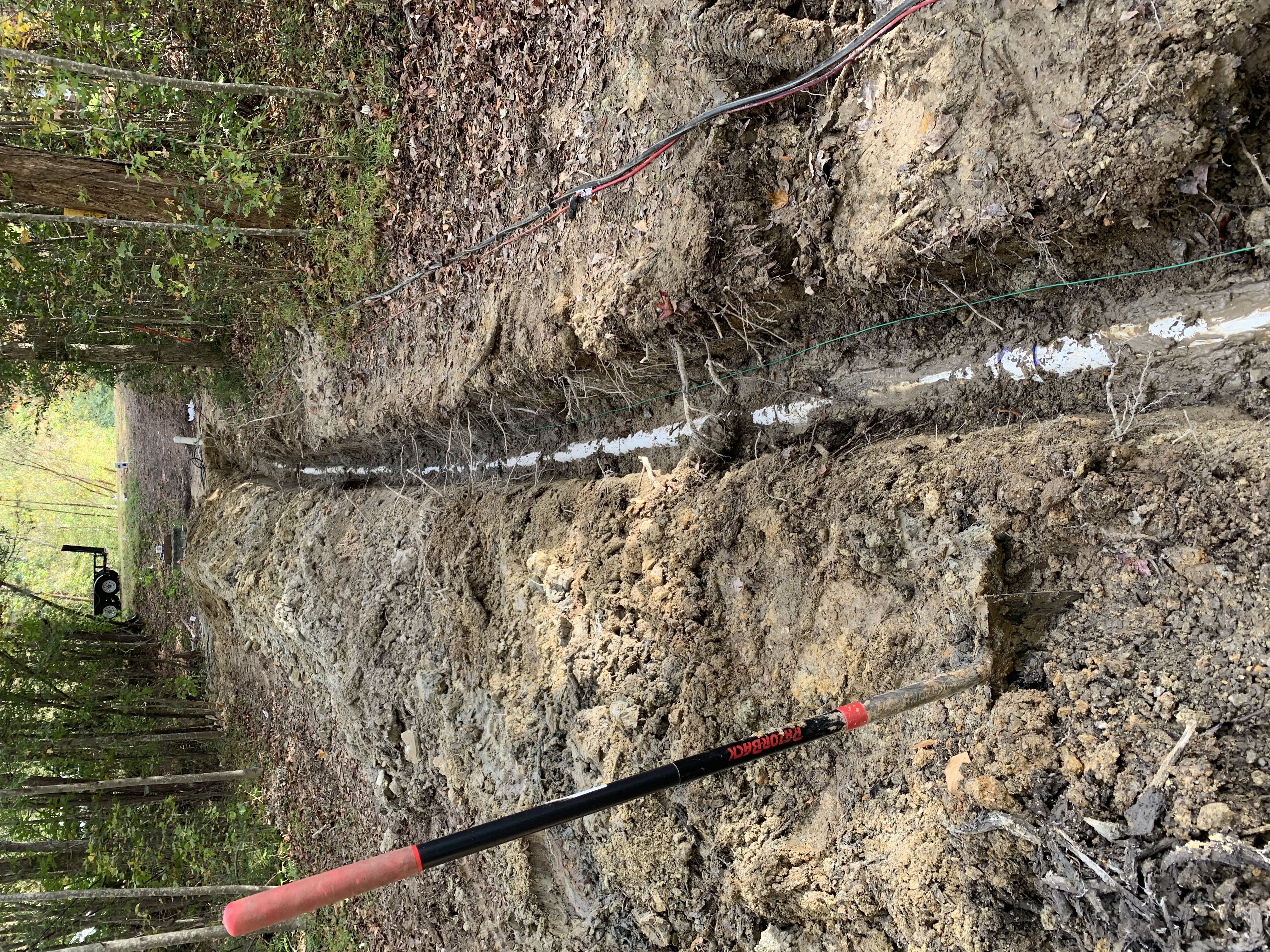
See all our Signature Work: real jobs, photographed on site, signed by the plumber who did them.
What it costs
Most sewer line repairs here run $1,500 to $6,500. Here's what puts yours where.
A spot repair on a shallow line in an open yard is the low end. A full replacement, deep, long, under a driveway, is the high end. Nobody can tell you where your job lands from the curb, and we won't try: the camera and the locator tell us, and then the price is written down before anything is dug. It doesn't change once you say yes.
Toward the low end
- One bad spot, found on camera
- Shallow line, open yard
- Cleanout already there
- Plastic pipe otherwise sound
Toward the high end
- Length and depth (the street end is deepest)
- Driveway, sidewalk, retaining wall, big trees, other utilities in the way
- Full replacement of clay or cast iron
- A permit and inspection, where required
- Restoration beyond raked dirt and straw
Before you decide
- Free on-site assessment during business hours
- Written flat price for each option
- Already have a quote? Free second opinion, on site, with our own camera
A sewer replacement is one of the biggest checks a homeowner writes to a plumber. Make them earn it.
We built ARC so the person showing you the camera footage has no reason to see more in it than is there. Read the full ARC Promise.
- Our technicians aren't paid based on how much you spend. If a spot repair will hold, that's what we'll recommend.
- You see the footage. Ask for it. Ask what you're looking at. Ask why.
- A quote shouldn't come with a countdown clock. A cleared line buys you time to think.
- Free second opinion. Someone quoted you a full replacement? We'll come out, run our own camera, and tell you if we agree.
From customers
What people say after we leave
5.0★ across 419 Google reviews.
★★★★★
"Highly recommend for plumbing service. Clay and Caden were prompt, polite, and did a great job. They thoroughly explained our different options and offered advice without pushing anything. This is probably the first time we've been blown away with a positive plumbing experience. Throughout the work they provided regular updates on status, work was done quickly, and no mess left behind. We will definitely call them again for future needs."
★★★★★
"We've had ARC out to our house for several issues and they are always quick, professional, and informative! Today we had Clay, Chris, Noah, and Cam all working on our sewer line, and they did an amazing job! ARC will always be the first people we call with plumbing issues!"
★★★★★
"We bought a fixer upper that needs extensive repair, starting with a cracked sewage pipe to restore service to the home. Clay not only gave me a fair quote and did great work but he advised me on several other issues we are facing. Clay and Chris both did excellent work and truly went above and beyond. Clay even offered to scope our sewer pipe when our inspector was unable to do so. They have made us Arc customers for life."
Questions we get
Wake County sewer line questions
How do I know if my sewer line needs repair?
Several drains slow at once, toilets that gurgle, sewage backing up into a tub or shower, clogs that come back after being cleared, a sewer smell in or around the house, or a strip of yard that's greener or softer than the rest. Any one of these can mean a cracked, blocked or sagging line. The only way to confirm it is a camera inspection, which is part of our free on-site assessment during business hours.
What causes sewer line damage in the Raleigh area?
Roots are the number one cause, and here crepe myrtles are the usual culprit; they find a joint that's already leaking and grow into it. After that: old clay or cast iron pipe failing with age, bellies (sags) where the ground under the pipe settled, joints and couplings that were never installed right, grease, and wipes. Older Raleigh and inside-the-Beltline homes may still have clay pipe.
Do you have to dig up my yard to repair a sewer line?
Finding the problem takes no digging; the camera and a locator pinpoint the exact spot and depth. Fixing it does: we excavate to the damaged section (for a spot repair) or along the line (for a replacement), keep the dig as small as the job allows, and backfill, tamp, rake and spread straw when we're done. You see what we found and get a written price before anyone digs. We don't do trenchless lining or pipe-bursting.
Should I repair or replace my sewer line?
One cracked section or one root-filled joint in an otherwise sound plastic line is a spot repair. A line that's old clay or cast iron, sagging, collapsing, or failing in several places is a replacement; repeated repairs on a line like that cost more over time than doing it once. After the camera inspection we tell you which, and if a repair will hold we say so. Our plumbers aren't paid based on what you spend.
How much does sewer line repair cost in Raleigh?
Most sewer line repairs in the Raleigh area cost between $1,500 and $6,500. A spot repair, digging to one damaged section and replacing it, is at the low end. Longer runs, deeper lines, driveways or trees in the way, and full replacements push toward the high end. What moves the price is length, depth, access, pipe material, and how much excavation and restoration the job needs. We confirm the problem with a camera first, then give you a flat price in writing, with no trip charge for the assessment during business hours.
How long does a sewer line repair take?
Clearing a blockage is usually an hour or two. Most spot repairs are done in a day. A full replacement takes one to a few days depending on length, depth and access. After the camera inspection we give you a timeline with the price. Your water stays on; you just can't use the drains while the line is open. For active backups we offer same-day and after-hours response.
Is the sewer line my responsibility or the city's?
It depends on the utility, and the two biggest in Wake County differ. Raleigh Water: the property owner is responsible for the line from the house all the way to where it connects to the City's main, including under the street; the City maintains the main. Town of Cary: the Town clears blockages from the main to the cleanout at the edge of the property, and the owner handles cleanout to house (with no cleanout, the whole lateral). Other towns have their own practice. Working out which side the problem is on is part of our assessment.
What is a sewer camera inspection, and do I need one?
A camera on a push rod goes down the line through a cleanout and shows the inside of the pipe on a screen, while a locator on the surface tracks exactly where the camera is and how deep. It finds roots, breaks, offsets, bellies and blockages without digging. We recommend it for any main-line backup, any clog that's come back, and before buying an older home. It's also how we make sure a repair is targeted instead of a guess.
Do you do trenchless sewer repair?
No. We repair and replace sewer lines by conventional excavation with new PVC, properly bedded. For some lines, under a long driveway or a big tree, trenchless lining or pipe-bursting is the better answer, and if the camera shows that's your situation we'll tell you and point you to someone who does it.
What is a backwater valve and do I need one?
A backwater valve is a one-way valve on your sewer line that stops sewage from flowing backward into the house when the public main surcharges. Raleigh recommends one if the elevation of the lowest floor of your house is lower than the closest upstream manhole, and suggests asking a plumber whether you need it. If your lowest bathroom has ever backed up during heavy rain, you probably do. We install them.
Do you offer emergency sewer service, and where?
Yes. For active backups and overflows we respond after hours and on weekends; those calls carry a flat $365 dispatch fee, confirmed before we roll, plus the cost of the work. We're based in Fuquay-Varina and serve Raleigh, Cary, Apex, Holly Springs, Fuquay-Varina, Morrisville, Garner, Wake Forest, Knightdale and the surrounding Triangle.
Sources
Where the facts on this page come from
- City of Raleigh, Raleigh Water. Sewer Service FAQ: owner responsibility for blockages between the house and the City's main; "request the plumber clear the blockage all the way to the City main"; backwater valve guidance; 919-996-3245.
- Town of Cary. Sewer Maintenance: the Town clears blockages from the main line to the cleanout at the edge of the property; the homeowner is responsible between the cleanout and the dwelling, or for the whole lateral if there is no cleanout.
- City of Raleigh, Raleigh Water. Know Your Pipes (updated July 16, 2026): "You are responsible for the portion of the sewer line that runs from your home to the point where it connects to the City's main sewer line."
- U.S. Census Bureau. American Community Survey 2019–2023 5-year estimates, table B25034 "Year Structure Built," Wake County, North Carolina: 481,999 housing units; 90,508 built before 1980; 161,194 built 1980–1999; 230,297 built 2000 or later.
- North Carolina General Statutes, Chapter 87, Article 8A, Underground Utility Safety and Damage Prevention Act, G.S. 87-122: notice "within three to 12 full working days before" excavation.
- City of Raleigh, Raleigh Water. Sanitary Sewer Overflows (updated August 27, 2026): grease and wipes as causes of backups; "No wipes of any kind should ever be flushed."
Sewer line trouble?
Camera first, then a straight answer: clear it, fix the bad spot, or replace the line